Wednesday, June 17, 2015

Weeds

My husband has a theory about garbage.  He says if you leave it unattended, it will attract more garbage.  I have the same theory about weeds.  I believe it is better to weed for 10 minutes every day than for an hour on Sunday.  By then it is a job.  No one wants to spend an hour weeding.  But most people can be talked into 10 minutes of the task.


Never pass up a weed.  If you say "I'll get it later" you won't.  Then there will be two of them.  Then you will say "I'll set aside some time tomorrow."  And you won't.  Whenever I do my garden walk through I take my weed pan with me.  You have to get down there to look for squash bugs anyway, you may as well pause for 5 seconds and grab that weed.  And that one over there.

There are always weedy enemies lurking in the hard to reach places

Whenever I harvest I bring my weed pan to that bed.  Harvesting peas is not as conducive to weeding as say lettuce is.  You won't be down on your knees.  But you will be looking deep into the pea plants looking for pods.  If there is a weed staring back, grab it!  Then take 5 steps back and drop it in the pan.  You can do it!

Lettuce is easy to weed as I pick
My enamelware weed pan is my trusty companion

It takes me about a week to fill this pan.  It stays in the garden all season.  It is cute enough not to be an eyesore.  It is heavy enough not to blow away in a storm.  It's big enough to hold a week's worth of weeds (mainly because I pull them before they get too big).  Now, if you've ignored all my previous advice about raised beds, intensive planting, not turning your soil and mulching, and you have weeds in volume that requires a hoe or a tiller, then I can't help you.  You're just going to have to spend your Sunday weeding.  I'm going to spend mine in the shade admiring my garden.

My Pea Patch in 2008, the last year before we put in the raised beds
Wow, that looks like a lot of work!

Sunday, June 14, 2015

June Update - Luscious Lettuce


This is one of those lush growing years.  I don't think the garden has looked this good since it's first year back in 2010.  I give credit to the rain and the blood meal I have added to all the beds.  Everything has taken right off.  We've had good growing conditions, plenty of rain, and sunny days.  I have also fertilized twice since planting with fish emulsion.


I am very happy that I finally bought the extra tall pea fence for the Wando peas.  They are reaching towards the top already.


The Maestro peas are just now ready.  I picked some and put them on my salad for supper tonight.  They are a more normal pea height and great producers.


But June is ruled by lettuce.  I remember when they were just tender little babies needing to be watered every day.  They look so cute at that size.


Now they have reached maturity and are elbowing each other for growing room.  There are three mature rows here and a new row planted down each edge.


I religiously spaced these plants 12 inches apart, but with the healthy soil and plenty of rain they have grown enormous!  I've never seen such large leaves!  I carefully removed any extra plants first.  For over a month I have been "pruning" them to harvest, taking only the outer leaves.


This week I realized the best course of action would be to just cut and remove every other plant.  It took a couple of days of studying before I chose which end to start on so I leave a perfectly balance selection of varieties in each of the mixed rows.  Now they have some elbow room and are off set so no one is pinned between two neighbors.  This morning I cut POUNDS of lettuce, rinsed it, and packed it into two gallon bags.   Besides here at home, and my office fridge, I am also giving bags and bags to my mother and co-workers.  There is enough lettuce for everyone!  Besides this bed, I have two mature rows along the peas, and one just started in the bean bed!


Remember the first signs of spring?  The survivors in the herb bed?


Well they are growing and spreading and looking beauteous.
Clockwise from the top:  Rosemary, common Thyme, Verigated (yellow and green) Sage, Verigated Thyme, Daylillies and Irises and a Nasturtium tucked in.  And right in the middle is the Tri-colored or Purple Sage.  I even think I have toad in my little toad house there.  There was fresh soil kicked out the doorway, but I didn't want to lift it up and disturb him.  That makes for a grumpy toad.


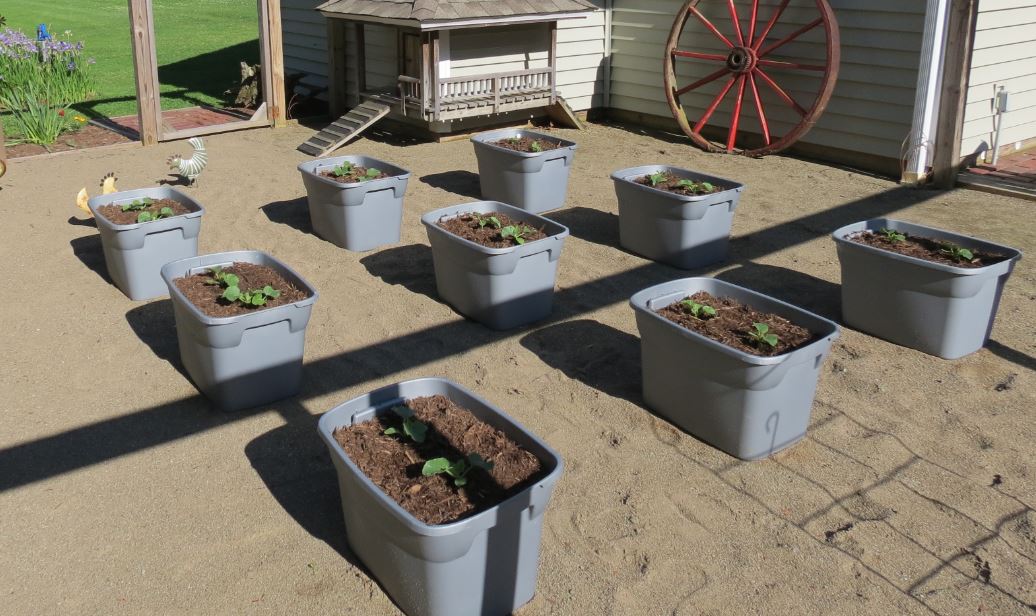
This year I am trying my cantaloupes in containers.  I really didn't have a good spot to rotate them to and I thought with fresh soil and the added heat of the sand in the chicken yard they ought to do well.


This bed held potatoes the last two years.  Now there are 4 zucchini plants in wire cages (just until they get big and prickly and inedible to the deer and bunnies).  The rest of the plants are weeds.  Well, weed-potatoes to be precise.  No matter how careful I am at harvesting I always miss some.  These are blooming now and within the next two weeks I will pull them, use the baby potatoes, and give the zukes more room to grow.  Those are a good kind of weed to have.

So, how are all of your gardens coming along this year?  This is the best time of year.  Enjoy!

Saturday, June 13, 2015

1.5 Ounces of Prevention

I like to think that part of my competence as a gardener has to do with learning from mistakes.  The way most of us start out is with some Dirt and Transplants.  After years of trial and error we advance to Soil and Seeds.  We plot and plan.  We kill and strategize.  We have our rituals all designed around avoidance.  Avoidance of pests.  Avoidance of failure.

You might ask me "do you have trouble with slugs?"  My answer would be "yes and no".  Not since the year of the cucumber failure.  I used to have trouble, now I avoid trouble.  We learn what is coming next.  We research and exercise solutions. Do I have any trouble with slugs?  No.  But that's not because I live in a slug free world.  It's because I kill every one I see.  Every time I plant cucumbers or lettuce I sprinkle Sluggo all over that very day.  I sprinkle Sluggo in the strawberries.  I pack it into the cracks and crevices that look like a slug hotel.  I don't have trouble with slugs because I am always at war with them.  ...even if they don't appear to be here.  I fight them before they arrive.  The same with squash bugs, deer, asparagus beetles, raccoons and flea beetles.  I am always at war.  Seems silly when there is no sign of the enemy?  Well, no.  That's just proof that the war is going well.  I'm winning!

Last year's battle was against fusarium wilt.  This is caused by bacteria in the soil.  It rots the roots and stems where they touch the soil, and the plant "damps off".  Perfectly good seedlings keel over.  Sometimes they rot before they even poke through the ground.  It's disheartening.  I struggled to keep ahead of it.

Large gaps are evident in my bush bean row where seedlings
damped off before they could become established.
I had the problem in two beds, one with black beans and one with bush green beans.  I've had this trouble in particularly wet years where I actually had algae growing on the soil surface in full sun, but waiting a few weeks and replanting solved the problem.  Not last year.  There seemed to be no stopping it.

Discoloration of the stems is the first sign of the problem
But one thing I noticed was that the black beans planted in the bed I'd amended for the cucumbers, were outpacing the wilt with their vigorous growth.    I could stand at the bed and see where I had added the blood meal (a source of Nitrogen).  The beans along the cuke row were thriving, but the beans on the other side were struggling to survive.  So... this could be prevented.

I added blood meal to the right side of the bed, but none to the left side.
This year I took several steps to ensure my beans survived.  First, I rotated them to a different bed which hopefully won't have a wilt problem.  Secondly, I solarized the bed in the spring, cooking the bad bacteria and warming the soil.  Thirdly I added blood meal to all my beds.  And fouthly, I inoculated them.   That isn't exactly what it sounds like.  Inoculation sounds as if I am giving them an immunity to disease, which I'm not.  I used a product that encourages "the formation of high-nitrogen nodules on plant roots for richer soil, bigger plants, and better yields".  .  I'm doing my best to help the plants outpace the enemy.

The inoculent came in a 1.5 ounce packet.  A black, powdery mystery substance.  You damped your seeds, roll them in the black, powdery mystery substance, and plant.  So far so good.  I planted two rows of purple and yellow beans from seeds packed for 2014, and on a whim used up the green ones packed for 2011.  The old seeds turned to mush and only a couple sprouted, so instead I've added a row of lettuce thinned from another bed.  The two goods rows are doing just fine.

In fact, I went a little over board.  These should really be thinned.

Sunday, May 31, 2015

To Buy or Not To Buy - That Is The Question

With all this talk of buying plants, you may wonder what I am buying.  Aren't true Gardeners supposed to grow everything themselves?  Well, yes and no.  There are only so many hours in the day, so spend accordingly.  There are also only so many dollars in the budget.

1.  Perennials:  We always seem to be adding landscape space.  While I am generally happy to admire a well mulched, freshly edged, EMPTY landscape space, Tim is automatically compelled to fill it with something.  Well, for ME to fill it with something.   Some of my existing plantings may become unbalance because of plants dying out and not growing well.  

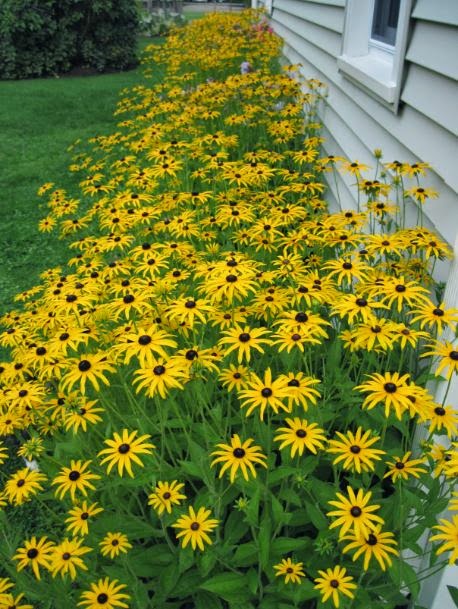
Once Upon a Time I bought some Black Eyed Susans....
And maybe a Hosta... or two
You can easily propagate your own perennials by Dividing or re-Seeding.  About 12 years ago I bought some Black Eyed Susans.  I now have BES in several places, have given some away, and on occasion will wheel a barrow out to the compost pile and murder them.  


And now they are every where

Same with Hosta and Phlox.  One well established and thriving planting can supply a neighborhood for generations to come.   But sometimes you just need something new.  Or something Right Now. So you pay for something that, with a little diligence, you probably could have gotten for free.

The simplest way to make sure you are matching your existing plantings
without remembering what variety they were is to divide or seed from what you already have.


2.  Vegetables:  Yes I do buy some vegetable starts.  A gal can't do everything.  There is an excellent blog here on Northwest Edible Life that perfectly explains what seedlings to buy or not to buy and why.  I plan my spring cold frame real estate carefully for early Lettuce, hardening off indoor starts, successive plantings of Summer Squash, Cucumbers, and Cantaloupes etc.  I have room for 8 flats at any given time plus a little edge space for keeping warm watering cans and a tub of potting mix.  Sometimes I feel I have room to plant Herbs or a certain variety of annual flower.  But they have to fit into the timing and space provided by the frame. 


I try to stick with a "hot" color pallet in the vegetable garden.  I only use red, orange and yellow.
Some years I buy Profusion Zinnia seeds by color so I know I will have only those colors.


I have two grow lights and heat mats (and space to put them in) to start seedlings indoors.  These are devoted to my Tomatoes, Eggplants and Peppers.  Sometimes I like to try new things like Jalapenos and I don’t have a preference for the variety so I will pick up a likely candidate at the nursery just to get me started.  The biggest problem with buying vegetables commercially is the limited selection and generic labeling (or miss-labeling).  Tag says Red Bell Pepper.  Yes but what KIND of Red Bell Pepper?  If I really like it will I ever be able to find the same variety again?  Or next year will you sell me another Red Bell Pepper variety with the same generic tag?  I am a self-professed Tomato Snob.  I want what I want when I want it.  I am also a well-rooted Eggplant Snob.  I don’t want to grow Black Beauty Eggplant every year.    And I am fast becoming a Pepper Snob.


Not everyone grows Purple Beauty bell peppers, and certainly not
people who buy their transplants around here.

There are some other vegetables that just don’t transplant well, but that doesn’t stop greenhouses from selling them to the unsuspecting public.  My neighbors routinely plant a couple of packs of Bush Bean transplants.  Hmmm… interesting.  Four plants for the price of 30 seeds.  To each his own.  The Beans transplant and produce well and they routinely have beans weeks before I do. But when they brought out the four packs of Carrots!  Now this was an experiment worth watching.  Carrots!  I kept mum but my eyes peeled.  I happened to be present the day the Carrot crop was harvested.  Neighbor Mike began pulling first one, and then a half dozen of the most fascinating Carrot Knots I’ve ever seen.  He was perplexed.  “What is WRONG with my carrots?!?”   Pest damage?  Some strange disease?  I couldn’t help but chuckle as I walked over to inspect.  “Didn’t get your roots plumbed when you transplanted them huh?”  After all, a Carrot is merely a root.  Even he managed to find the humor in it.

3.  Herbs: This seems like one of the most obvious grow your own projects in the garden.  Every housewife in America can grow that stuff on her kitchen windowsill.  With the cost and variety of seeds available only a dummy would buy a Basil plant.  Well count me in.  I don’t have the inclination to fiddle with Basil anymore.  Or Cilantro.  Just give me a couple of pots and I’ll be on my way, thankyouverymuch.  

One Red Rubin Basil seedling will soon become a shrub

I do have well established crops of the hardy, woody stemmed Herbs planted in permanent locations.  The Catnip shows up here and there in the garden each spring and I rip the little buggers out by the roots and put them in a large planter where they belong.  But they will wander off… they always do.  I doubt I will ever have to buy Catnip ever again.  I am helplessly drawn to the Herb selection at every greenhouse.  An unusual variegated variety will get me all excited.  I just can’t resist them.  I really don’t use them, not as much as they deserve to be.  So they grow happily and un-harvested to shrub size, attracting pollinators with their blossoms and self-seeding themselves all over the place willy nilly.

Large rocks shelter and warm these herbs and keep them alive through harsh winters


4.  Annuals: There are plenty of annual plants that can be started from seed, cuttings, or even wintered over.  My grandfather and mother-in-law had Geraniums as old as I am.  They would just bring the pots in every winter, put them in the barn or the basement, and haul them back out in the spring.  My mother had Petunia plant (maybe still does. ) that we picked up at my PaPaw’s greenhouse back in the early years when the Wave Petunias first came out. That was back around 1998 or 99 and I know I saw it in the dining room last year, rambling up towards the drapery rod.  I could keep a “seed” Geranium over each year and start my own cuttings in January and save myself $60 every year.  If I were so inclined.  But I’m not.  I’ve considered pulling the Marigold volunteers each spring and potting them up alongside the Catnip.  That project interests me a bit more.

A tub of Calibrocha "Million Bells" Petunias can add color to any corner

So each year I adjust my shopping list keeping old favorites and adding new novelties.  I lurk about the local nurseries and scatter color all over our acreage.  Shades of pink and white around the house, hot red orange and yellow for the garden, and on to the side yard whose remoteness enables me to play with the color pallet each year.  I don't have a "flower garden" and yet I still manage to plant almost 100 Marigolds, 20 Geraniums, a few dozen Petunias, Portulaca, Alysum and various and sundry Spike and Vinca and other fillers.  I find volunteer Petunias and Portulaca in the midst of Sweet Potatoes and Cucumbers.  I don't pull them.  They're not really weeds.  They're just trying to give me my money's worth.

What's that peaking thru the carrot tops?  A Petunia!


Wednesday, May 20, 2015

To Plant a Garden is to Believe in Tomorrow

I read this sweet little inspiration phrase in a gardening book, and my first reaction was “yet so many garden with total disregard for tomorrow”  For example, people who plant in the ground before the last frost date or buy over-grown root-bound potted plants and hanging baskets they will never water. 

I guess I am the tomorrow kind of gardener.  I am always the one buying the short, stocky plants that haven’t bloomed yet.  When I see a particularly nice combination potted up, I march right past those and head out to buy the individual components to plant up myself.  That way I get younger and healthier plants that are not already root bound and hard to maintain.

A basket full of Calibrocha may look beautiful today, but buying the individual plants
and planting fewer per pot will make them easier to maintain.  These baskets usually burn out
for me within 6 weeks while my own plantings peak a little later.

Today I passed up the rack of hopelessly wind burned pepper plants and went through the show room with it’s tempting selection of a little of this and a little of that and back to greenhouse # 8 (out of 21 in the large glamorous garden center with the concrete walkways and shopping carts) and found the protected and fresh stock of pepper plants, pulling flats out so I could step back to the wall with the shortest, deepest green and most enticing plants.

Newly germinated seeds shelter in the warmth of the cold frame
along with annuals fresh out of the commercial greenhouse.

Gardening is about patience.  Sometimes you get instant gratification by going out and buying a beautiful selection of plants or shrubs and transforming a dull or unkempt portion of your garden into a virtual Eden.  But usually gardening is a long process.  In the last post I wondered how many greenhouses I would manage to visit this year.  So far six at least once, and I am on the third round for several suppliers.  I have also visited two Big Box garden departments for various supplies, and have two more greenhouses on my wish list mainly for tourism purposes. 

A trunk full of Geraniums will take over
an hour to transplant properly

Why so many trips?  Because it won’t all fit in my car all at once.  And if it did, the sheer enormity of the task would be overwhelming.  I walk into a well stocked greenhouse and I am immediately overwhelmed and underwhelmed at once.  There are so many beautiful choices, but the I can’t always find the exact variety or color I have in mind.  If I did manage to find everything I wanted all at once, I would not have room to stage everything and keep it protected until it is safe to plant and I certainly wouldn't have the energy to plant it all at once.  This must be done in stages. 

On one side the hoop house with a frost cover shelters tender seedlings
from direct sun and wind.  On the other side, sturdier, hardened off
plants await transplanting after threat of frost.

Last Friday I planted 16 gallon size perennials in the new rock arrangements between the trees.  This is in an area that was previously lawn and requires digging through sod and amending the soil.  Rain storms were rolling through and I had to do it in stages.  Plant six plants, get rained out, pack up, flee to the house, check the laundry, check the weather radar, start all over again.  Then on Sunday I planted a whole flat of marigolds.  With list in hand I made my rounds depositing the planned number of packs in each area, then I went back through with a trowel digging them in.  Saturday I filled large pots and added soil to the stationary planters, shoveling compost and wrestling with heavy pots.  Today I was back to the nurseries for another car full of plants.

Half of a rainy day's work

Another reason to do this gradually is that greenhouses stage their plants in cycles.  They can’t do it all at once either.  First come the perennials and hardier plants, then the bedding plants and vegetables, and finally the hanging baskets and combination pots for the finishing touches and color refreshers.  I have hanging baskets on my list and I know the best place to get what I want, but they are still in their beginning stages and not yet beautiful and tempting.

The bad news is that half of our clump Birch tree died.
The good news is the smooth red bark of the branches make
an attractive support for the pot of 3 foot high Sweet Peas.

Back at home I have a large population of plants to harden off and coddle and protect until after threat of frost and high winds.  The most finicky live in the cold frame and must be moved in and out and placed in sheltered spots until they become hardened to the sun and the winds.  There are adolescent plants who have graduated to the garden paths and which can be covered with my miniature hoop house if frost threatens.  Then there are plants ready to go in the ground, staged beside their intended beds, waiting for a free moment between weeding and watering and mulching and carrying to get settled into their permanent homes.  Today’s work was to pot up some decorative pots of Portulaca and Nasturtium.  I still have 15 (a trunk full of) Geraniums to fetch, carry home, and plant.  But there’s always tomorrow.

The garden peas are doing well, and the oldest planting of leaf
lettuce is supplying us with salad greens.

Wednesday, May 6, 2015

And All of a Sudden It's May

And it feels like June.  But that's OK by me.   This is the fun part of the year.  You can sleep with the window open, falling asleep to the sounds of tree frogs and awakening to the singing of birds.  There is a lot to do but we're still not over the rapture of being outside in the sunshine at any temperature above 10*F.  And it's Spring Cleaning time.

I was thinking the other day that the only thing I do anymore is clean.  Clean the house, wash the car, do the dishes, wash the laundry, bathe the horse, clean the saddle, scrub some boots, sweep the steps, shampoo the cat (yes, she needed it), paint the benches, shower, wash the dishes (again)... you get the idea.  This weekend we washed the front porch which involves taking all the rockers out in the sun, hosing the road dirt off the walls and floor, and washing the furniture before putting it all back again.  Now I can invite guests to come sit out there without worrying that they might ruin their clothes.  I even washed our mailbox.  It was so icky with road dirt,  Whenever I put a pretty pink enveloped greeting card in there I'd cringe.  But I felt like an obsessive compulsive nut standing out there by the side of the road with a pail of hot soapy water and a brush.

It is also Spring Landscape Blitzkreig time when we go through about 20 cubic yards (no joke) of mulch and cut over 800 feet of edging (I measured on the GIS site). It used to be 650 feet, but to streamline the mowing pattern, Tim turned five 60 inch circles around the Linden trees (80 feet of edge) into one long six foot wide swath (216 feet of edge).  Now he can zip down the line at 15 mph instead of turning precise circles.

My husband's idea of the perfect pin-up girl
Above is what I think must be my husband's ideal Pin-up girl.  It isn't her svelte figure or her lovely brunette complexion...no it's that edging shovel.  Hey even I wouldn't mind if she wanted to stop by and help with the edging.  My fetching smile disappears sometime around day three (800 stomps of the 7 inch spade).   Tim is always saying to me "If you have a boyfriend, now would be a good time to fess up.  I have a lot of work to do this weekend, and it sure would help if he'd stop by and give me a hand."

The Linden trees Before and After

Besides Spring Cleaning and Landscape Blitzkreig things are ticking along in the garden like clockwork.  The peas are up, the strawberries are replanted, the lettuce is ready for transplanting and the tomatoes, peppers and eggplant seedlings have moved out to the cold frame under a layer of shade cloth.  My father even announced that he was going to go ahead and plant tomatoes well aware that he might have to cover them more than once.  Or 20 times! 

And that long swath of mulch between the Lindens has been arranged with clusters of boulders from the farm.  I plan on planting grass-like perennials around them to add interest.  Mostly day lillies and Siberian irises and strong smelling herbs and other things the deer don't bother (much).  I've been wandering the nurseries and greenhouses with a note pad writing down varieties and prices and sizes.  I feel like a secret shopper or price spy.  But the growers know me by sight and they're used to my wandering around for hours reading tags and poking at plants and leaving with nothing but a flat of marigolds and a bag of blood meal.  I always come armed with a box and garden clogs and I remind myself of my mother's favorite greenhouse patron who used to show up wearing rubber dish gloves.  May is when I indulge in my own version of Agri-Tourism.  Let's see how many greenhouses I can get to this year!

This is the porch last May 24, so no, our flowers are not this nice yet!

Sunday, April 19, 2015

April Happenings: Spring is Here


We've made a start on the edging and mulching

The lettuce has just poked through and it is hard to believe
that these teeny tiny leaves will amount to anything
The Daffodils are just beginning

The peas came up on Thursday, Day 14 and
I planted the second planting on Friday evening

Tomatoes are seeded, peppers are just making a sho
 and the egg plants are looking luscious