Showing posts with label Dry Creek Bed. Show all posts

Saturday, September 5, 2026

Update on an Old Undo Redo

Three years ago, this view with the tall grasses right next to the lawn began to vex me.  So I moved the two tall Overdam grasses to another area, along a fence where they can be as tall and skinny as they want to be.  I had some Karley Rose grasses to the right, but they were not thriving in the wet ground, so the next year I replaced those with Niagara Falls Panicum.


The Niagara Falls grasses are doing well in the soggy soil and their size really anchors this space.


The right plant in the right place. 

Wednesday, June 17, 2026

Perennial Optimism

 Every year I lose a few perennials, and last year I did away with a whole bunch of Day Lilies and a few Hosta because I was tired of fighting the deer for them.  Most of this happens in our big Dry Creek Bed.  This area is pretty challenging to plant because it is both a hot, dry area and a wet area, depending on the season.   Below is an example of one of the planting spots vacated last year by a Day Lily.  The Day Lilies and grasses push a pretty sizeable root ball up from grade which seems to help them deal with the soggy season.


Because when it rains, some of these holes can really fill up with water!


When I first planted this area, I started with dependable plants like Decorative Grasses, Day Lilies and Hosta. Over the years I have also tried and failed to add some color with Blanket Flowers, Salvia, several varieties of Echinacea and newer Rudbeckias.  I tried some things that don't do well for me anywhere in my garden:  Candy Tuft, Sedums, Plumbago, Coreopsis and Caryopteris. I've planted four or five different varieties of Butterfly Bush.  Only one variety of these does well, but I am tired of replacing them every two or three years with volunteers I have collected up and groomed as under studies.  I tried some things that the deer absolutely obliterated like Irises, Asters and Marshmallows.  I still haven't gotten around to some of the brighter things like Phlox.  Some of the planting spots I have replanted three or four times and failed with every new idea.

Instead of going for colorful flowers I have switched to texture and colored foliage which brought me to shrubs.  Some of these have done well and some haven't.  I've discovered a few new to me plants like Amsonia and Penstemon which, so far, seem unstoppable in difficult locations.  When online perennials get discounted towards the end of each spring, I buy the smaller pots at half price, pot them up in larger pots, and grow them up to a retail size before planting them out.  This year, to fill the holes left by the murdered Daylilies, drowned Butterfly Bushes and finicky Echinaceas, I needed a dozen new Perennials and Shrubs.  I chose all new varieties concentrating on plants that look like they belong along a natural creek bed.  When searching through possibilities, I filtered for Deer Resistant and Wet Site Tolerant.


Physostegia Summer Snow (Obedient Plant)

Lobelia Starship Scarlet (Cardinal Flower)

Cimicifuga Black Negligee (Bugbane)

Aronia Berry Scape (Choke Berry)

Clethra Sugartina Crystalina (Summersweet)

I also got a few more Amsonia, Brunnera, Carex grass and Niagara Falls grass because I know those will work here and what I have is still too small to divide at this point.  I topped off the empty holes with fresh soil and got rid of all of the opportunistic weeds that had tried to take over.  Some of these new perennials were already getting root bound in the pots I put them in last month.  I hope this means they will root in fast and take off.


I love having a fresh new perennial in a tidy planting space.  So much promise.


Unless you were to walk through the creek bed, you really wouldn't have noticed those dozen empty holes.  What survives from year to year looks beautiful in June.  Here are a few shots from the last week.

Early Morning Sunshine

The Layered Look

Hosta corner in the dry shade of the Black Maple

Penstemon Onyx And Pearls (Beardtongue)

So now the vegetable garden is in, all of my annuals have been planted, and now all of the new perennials have been placed out in the dry creek bed.  I think I am, at last, done planting for the year.

Tuesday, August 27, 2024

Morning Light


This time of year the River Bed garden is such a peaceful place


Especially in the morning light


Sunday, July 21, 2024

Adding to the Riverbed

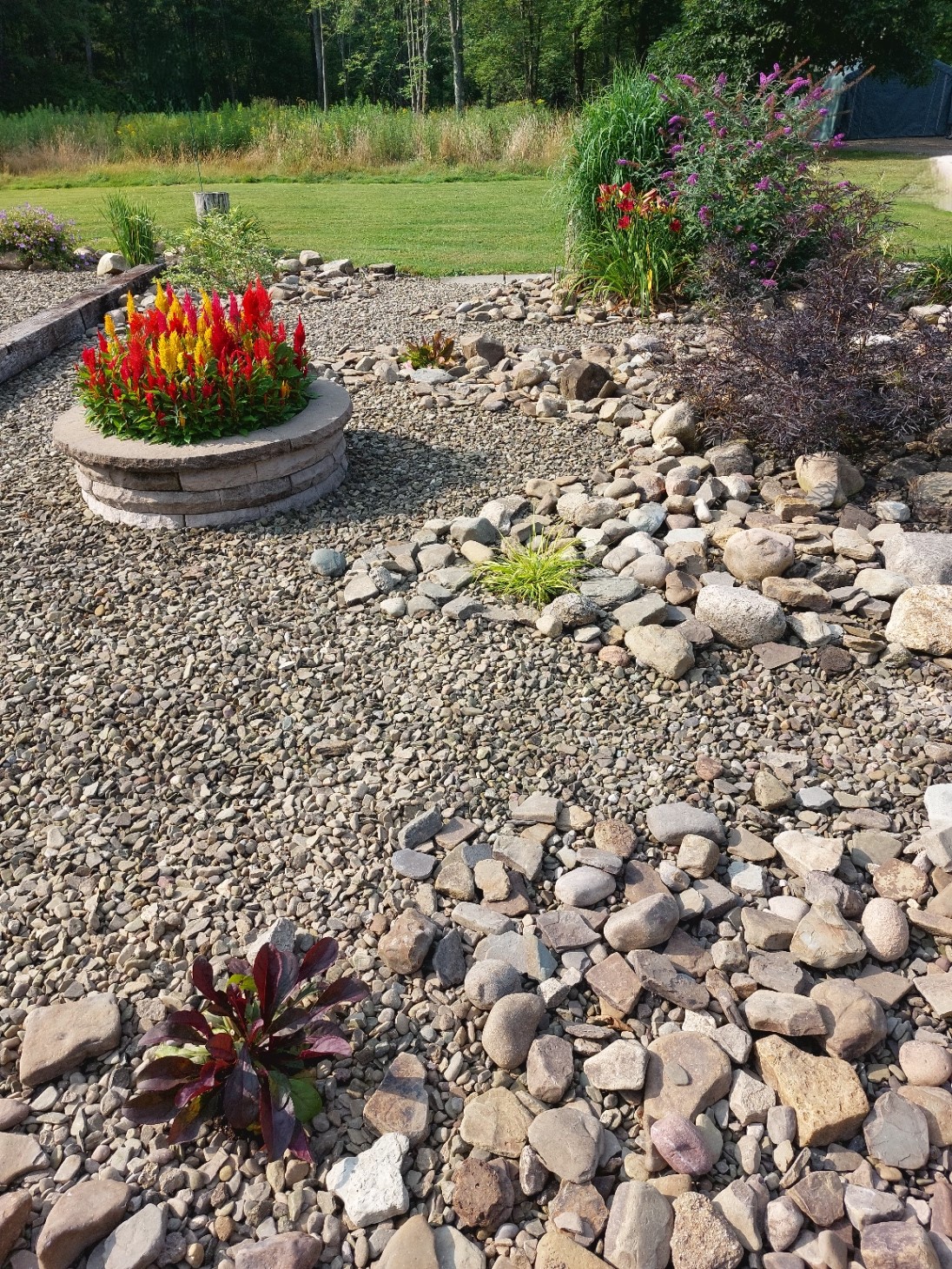
Last summer I wrote about making plans to add some color and variation to the one end of the big dry creek bed which used to have a straight line of RR ties holding back a low terrace. I wanted to add dark red and yellow, and add variation to the straight line that was caused by planting along those RR ties.  I purchased the plants this spring, but waited until we added more rocks before we chose spots and planted them.  These plants came in 3.5" pots from Bluestone Perennials and I planted them the same day in the large fiber pots with Miracle Grow Moisture Control potting mix and Espoma Bio-tone Starter Fertilizer which is awesome stuff.  They took right off, and the roots were filling the entire pot.

I've learned a few things over the past few years about planting in this situation. 

Plant #1 2019

When we initially planted this project, I was just using gallon sized fiber pots and I have since changed to using wider ones measuring about 11x10.   I initially only cut a large enough hole to sink the pot.  This hasn't been a big problem.  As you can see, most things are thriving ...

The down side to planting so restrictively is that when the more vigorous grasses try to spread, they strain against the surrounding road fabric, which doesn't hurt them at all, but it makes it completely impossible to divide them.  Plants with smaller bases, such as daylilies or the shrubs do just fine.  I have widened some of those holes but a lot of them are exactly the same as they were when first planted.

Our initial planting was sixty holes.  The year after we added almost two dozen more. I may have added one or two more single holes, but the change in the size of containers occurred between the first sixty and the next round of mass planting.  At this point we are cutting the road stabilization mat twice the size of the large container, removing the native soil (packed gray clay) and replacing it with a mixture of clean and fluffy native soil and potting mix.


I set the pot in the hole a few times to check the height.  Another thing I have learned is to plant them higher than you think you should because they settle over time.  Maybe not the first year, but by the second year the plant will sink.  This time we also removed the fiber pots because the plants were filling the container, but not firmly rooted into the fiber, and this saves us from having to look at the rim of the pot for a year which drives my husband a little nutty.  After a year or two the fiber breaks down enough that you can just pop the rim off right at the soil line.  In the mean time it looks like a pot sitting in a hole...


We pack the soil in and water well to remove any air from around the roots.


Then the gravel and rocks are replaced right up to the plant.  When the plant grows it will push the gravel away with no problem.


The plants I chose are:

Onyx and Pearls planted elsewhere

Husker's Red with some late flowers

The Penstemons have beautifully shaded red and green foliage.  When they bloom in June they will be quite tall but when they are through you can trim them down to whatever height suits you.  Both of these plants bloomed in the containers while I had them in the garden and they were very easy to care for.  I planted a few more in the river bed in spots vacated by Cheyenne Sky Echinacea.  I have no idea why those plants died over a mild winter.  They had done well the winter before, but I had them planted in threes and I lost 8 out of 9 plants. The one I salvaged was planted in another spot and is doing just great.

The Lemon Squeeze grass was my solution to the "yellow" color.  It is a bright chartreuse and should produce seed heads fairly early in the season as the Karley Rose does.  The Karley Rose was rescued from the warf where it was struggling with wet feet this year.  I replaced it with Niagara Falls Panicum which should do OK with wet feet.     


Monday, July 8, 2024

More Rocks

 Yesterday we made another trip to Dad's creek for a load of rocks.


Dad's creek is a wonderful inspiration for all of our dry creek bed areas.  This is Hatch Creek which I spent hours and hours playing in when I was a child.  The section I played in then was half a mile away behind my parent's greenhouse.  
  

Because we have no water, our creek beds will never look like this...


But we can make it look like this....


This was what we were left with in April 2023 when we removed the RR Ties.  The straight edge made sense when there was a line of RR ties holding back a terrace, but it needed to be blended in.  Picking rocks by hand can be quite a bit of work, so we kept putting it off.


This is what it looks like now.  We will sprinkle some gravel in here and there, and by the time I get done tripping over the rocks a few times, they will settle into more natural positions.


Last year I was brainstorming what plants I would like along this edge.  I have two Penstemons and a Lemon Squeeze fountain grass potted up and ready to go.  And I have a couple of Karley Rose fountain grass that need to be rescued from another area that is too wet and they can go here too.  I have Niagara Falls switch grass on the way to replace the Karley Rose.  I can divide some Black Eyed Susan next spring. (I will NOT be dividing any Daylilies LOL!)  Then I'll see where I am and if anything else should be added.

Thursday, September 14, 2023

Uprooted

 Remember when I said this tall Overdam grass was grating on my nerves?  Well, I pulled it out.

So much better!


I had some other ideas for more drapey grasses, but after looking at this with no grass for a few days I decided I needed a really, really low grass.  And I have some of that.  So I dug up some Carex Ice Dance and planted it in the blank spots.


This is a very vigorous grass.  I bought three of them a couple of years ago and now I have them in eight different spots.  They divided really easily and are impossible to kill.


This is what it will look like next summer.
Problem solved.
I replanted the upright Overdams along our split rail fence in another dry creek bed where their pillar-like uprightness doesn't look quite so jarring.

Work to be Done

Back in July I did a post on how well the dry river bed garden had filled in this year.  Last year, some of the grasses were slow to respond.  I divided a few hoping to rejuvenate them.  I relocated some that were in too much shade.  Just about the time they began to look lush and put out their beautiful seed heads it was time to cut them down.  That is a process that I have resisted each autumn.  But it really is a necessary step.  The first winter I left the grasses standing.  In the spring it was a horrible mess.  The damp, dead grass did not pull loose like day lily foliage and it was also nearly impossible to cut with shears or any other battery powered tool I have.  Lesson learned.  Now the grasses get cut down the first of October before the tree leaves fall and before the frost knocks down the grass.

The River Bed in July
This is the first year that I have begun to look forward to cutting this down.  It beginning to look pretty wild and wooly.  There is a lot of work to be done.

...and today
There are a few things that remain uncut.  Namely the Butterfly Bushes, the Button Bush, four Elderberry bushes and a Ninebark.


All of the tall grasses need to be cut close to the ground to discourage rodents from nesting in them and destroying their roots.


The Coleus have almost completely outgrown their container, but the Heuchera in the whiskey barrels are actually evergreen and will only require some cleanup in the spring.  I will need to keep them protected with some wire and perhaps a frost cover because while the deer leave them alone during the summer, "green" foliage in the middle of winter will be a rare treat.  This spring they found one I left unprotected and ate it down to the roots.  It took three or four months for it to recover, but it survived.


The Hostas are still small and can easily be trimmed with scissors or pruners, but the grasses have to be contained in a twine or bungy cord as best we can and cut with the Stihl Kombi power scythe


So the days are numbered.  We will start with the rest of the landscape, removing the many daylilies and other tired perennials.  At this point any remaining daylilies are just piles of dried grasses and I have continued tearing them out by hand as I start with the worst looking areas nearest the house first.


The giant Black Eyed Susan has continued to look nice despite flopping over.  I don't remember an year where the BES flowers have looked fresh more than two or three weeks, and this plant has been putting on a beautiful show since the first week of August.  Otherwise I would have cut it back weeks ago.

Friday, August 11, 2023

Making Plans

 Throughout the season, and especially towards the end of the season, I begin making notes for next year.  Things I want to do differently.  Things I want to move.  Things I want to add.  The things I want gone get gone right now.  But I have a shopping list started in my mind already and that will keep me occupied through the long, cold winter.  One thing I want to do is add to this end of the riverbed,

Back in April we pulled a row of railroad ties out of here to reuse elsewhere and it changed how I see this edge.  Now that I've walked past it a hundred times in various stages of growth and color, my mind is coming up with a plan.  I have spent two years tweaking the view from the firepit seating area and am very happy with that and now it is time to make some changes here.


I need something on the left between the tall grass and the red daylily.  I want something black to go with the Black Lace Elderberry on the right.  And I want something I don't already have.  Like Penstemon.  Penstemon comes in black foliage.  And it can't be a pink flower.  So black with white. Like Onyx and Pearls.


And then I have a wide open space that needs some yellow or lime.  I will have Black Eyed Susan to put there in the spring.  But that blooms late.  I might want to use an Echinacea instead.  I could divide a daylily but this time of year I am all daylilied out.  I already have a hundred daylilies  Maybe a Coreopsis or an Achillea.  Yup, that will keep me busy researching and imagining for months.


Then to the right of the Black Lace I need another splash of red.


Once again I have red day lilies that could be divided.  But you can have too much grassy texture.


Maybe Monarda instead?

The possibilities are endless