Sunday, June 23, 2013

The War of the Roses

I beg your pardon...
I never promised you a rose garden....


You may remember my apple orchard from an earlier blog entry. This year would be it's 75th birthday. Happy Birthday Apple Orchard!  It was planted by my grandfather's brother and takes up 2 acres or so on my farmland on the other side of town.  We don't do too much with it.  Sometimes I ride my horse through there.  A horse can make an apple sound so luscious.   Every couple of years the orchard pulls out all the the stops and gives us a marvelous crop of apples. But mostly, I look at it and think of all the work to be done in there. 

Apple orchards are difficult to mow.  The branches are not pruned and its hard to get a tractor under there.  If a limb falls, you either mow around it, or get out the chain saw and have a bonfire.  If you mow around it, eventually a Multiflora rose will take hold in that spot and engulf the tree.  When the tree dies and falls, you will have a brittle tree carcass in the middle of an eight foot high wall of impenetrable angry thorns, and then you have a real problem.  


Before Number 1

And that is what we had.  A real problem.  We talked about it for a few years.  We knew what had to be done.  We just hadn't worked up the gumption to do it.  My uncle or step father have gone in there and made a few passes with the brush hog so we could at least get to the producing trees.  What we needed was an all out war.

Before Number 2

It has been at least a decade since any cattle were grazed in there and in that amount of time the Multiflora Roses took off.  

Multiflora Rose History

In 1866 the rose bushes were imported as root stock for ornamental roses.  Then, someone got the idea that they would make great hedges for livestock fencing.  Yeah, well...  bad idea.  They are now a VERY invasive species throughout the eastern US.  Once they get started its hard to stop them.  Luckily, they probably do make excellent hedge row fencing for livestock, because once they take over your fence row, there ain't no way you're gettin' to the fence to fix it.  The roses owe you.  They had better keep the cows in.


Before Number 3

Above is the main gateway to the orchard.  The gate would be that large dark mound in the lower left and beyond that is an invisible drainage ditch four feet deep by twelve feet wide with a barbed wire fence on the other side of it.


My Friday day off dawned bright and early.  The first day of Summer.  A beautiful day to work outside.    Temperatures in the mid eighties and sunny skies were forecasted.  I put on a long sleeve denim shirt, some heavy leather gloves, nearly ruined blue jeans and some stiff leather boots.  Ahhh...  summertime.   My stepdad started early in the morning and mowed the high grass up to the worst of it so Tim could get in close and assess the situation.  Assessment:  The rose bushes dwarfed the tractor.  Where would we ever start?  Was this a futile effort?  What were we thinking?


Tim lowered the front end loader and began driving at the wall o' roses from various directions, pushing and crushing the fallen apple trees in their midst.  Within half an hour he had a 50 foot long angry windrow of thorns aimed at a break in the fence out to a small field we had designated for the burn pile.


We were going to win this war.


Some of the roses were three or more inches thick at the roots.  Tim took the time to backhoe these spots out along with what was left of the tree stumps to make the area mowable in the future.


An hour and a half later the front corner was cleared.  in the meantime, Stepdad Richard was mowing.  When the worst of that was done, they both attacked the rose bushes.  They would drive up along a tree trunk and scoop the roots of the rose bush out and then mash it into a ball to be pushed to the pile.  Dead  limbs were chainsawed into manageable pieces and pushed along with.

The white blossoms in this tree are NOT apple blossoms.  They are roses.


In some cases, the rose vines reached 30 feet or more into the trees.  It was my job to pull any of these out by hand.  It was then I discovered a rose pollen allergy that kept me sneezing all afternoon.

After Number 1
The 10 foot wall of roses is history!

After Number 2
Note the dark pink roses along the bank which are leftover from a house that stood here before our family came to the farm over a hundred years ago.  We call them the "Stoddard Roses" after the housewife who likely planted them,


After Number 3  The gate has been pulled out and the deep drainage ditch uncovered.
Halfway through the day we attacked the gateway.  It didn't take long for me to decided that a weak pipe gate, an undermined gatepost, and three decent strands of barbed wire were not worth the hassle to salvage.  I wrenched the gate off it's hinges, Tim reached in with the back hoe and scooped out a grand daddy rose bush, gate, gatepost, wire and all.  Some things are just not worth the trouble.  We can put all that back later after the roses are gone.


Seven hours later, we had an orchard again.  A neighbor on her way to feed calves at the dairy next door stopped and came walking out grinning from ear to ear "Now that's what I call a good day's work!"

The Part We Saved for Later

We did stop about a hundred feet short of the back fence leaving about a fifth of the orchard untouched. We told ourselves we were leaving "habitat" for the birds and the rabbits, but really, we were just darn tired.  And we have enough fuel for a pretty good bonfire, the pile is almost 30 feet square and 10 feet high without adding the large limbs we set aside to cut for campfire wood..  We can always come back and have another go.


Neither Tim nor I, nor my Stepdad want to see any rose bushes for a long time.  

Thursday, June 20, 2013

School's Out!

In two weeks we will attend my 25th high school reunion, and after all these years I still recognize the last day of school.  As I write, just 5 minutes ago, an off schedule school bus caught my attention as it drove past my office window and I realized….  Half Day… School’s out!  No matter how old you get or how far removed you become from the rhythms of childhood I think that still strikes a chord.  The summer is stretched out in front with endless promises and the heart is unfettered by routine.  Suddenly it is easier to get out of bed in the morning and we do not think of returning home until the fireflies light up the tall grass.

This week and next week are shaping up to be the nicest weeks of the year and it’s a perfect day to be the Last Day of School.  I remember my first last day of school like it was yesterday.  Or more particularly, the day after… the first day of my first ever Summer Vacation.  It was 1976 and the Bicentennial was all the rage.  Everywhere you looked there was red white and blue.  I had a brand new pair of red white and blue Keds sneakers and a matching outfit with red shorts and a red white and blue striped tank top.  I awoke on that perfect, bright June morning which was just like today, warm and clear and bright, with a sense of occasion I put on my favorite outfit and slammed out the screen door to the backyard.  My pony was housed in a shed in the back yard and to avoid wetting my new Keds in the dew, I balanced along the stone pavers which outlined a bed of Lily of the Valley along the back of the house.  What I did the rest of the day I don’t remember.  It probably ended up being like any other day, but that first morning sense of adventure is hard to forget.

Mom helps me give my pony a summer bath 

I was five years old and we still lived at the Greenhouse.  The busyness would be winding down as most bedding plants and vegetables had already been purchased and planted, but at my Grandparent’s farm, haying would be in full swing.  The farm was a red barned haven like all old fashioned farms were.  They smelled of clover hay and molasses not silage, and the cows slept on beds of golden straw harvested from one field of oats not sawdust delivered by a truck.  There were shady maples for climbing and calves and kittens for playmates.   Summers on the farm were so perfect that the autumn before, as I hung over the seat back of the old LTD car on the way to the County Fair and my Grandparents asked me if I were excited about growing up and going to school, I answered an honest “No!”  And now it was all behind me and the summer was back.  Yes, that was a magic day.

My Grandfather, Grandmother, and Uncle with the baler in 1976
Today in the garden, things are going well.  I seem to have outlasted both the Cucumber Beetles and the Flea Beetles.   I haven’t had to kill more than two or three bugs a day for the past several days and I have uncovered the eggplants.  They sustained some damage, but not enough to stunt them like last year and we already have a flower!  


The rows of potatoes that I also kept covered so as to remove a large food source for the Flea Beetles are now straining against the top of their floating row covers and will have to be uncovered.

The Potato Patch

The peas are ready to pick in quantities large enough for supper, and I still have 5 portions from last year in the freezer.  I rationed them out, but this is the first time I’ve made it full circle without running out of garden peas.  I also have potatoes left... slightly shriveled, and sprouty as heck, but I had enough to plant this year's crop and I believe we will make it full circle with the potatoes as well.

Purple Pea Blossoms

  One pea plant has unique purple blooms instead of white.  I also have 5 portions of sweet corn left and a gallon bag of green beans which will have to last until August as I plant beans late, after the peas have been pulled.  And I have a Zucchini started!  Let Summer begin.

Thursday, June 13, 2013

Cucumber Beetles

Besides Flea Beetles, I have managed to grow a significant population of Cucumber Beetles.  The first several years of gardening there were none.  Over the past 3 years I've seen one or two a year but they haven't proved to be too much trouble.  Last year they were on the rise and I bought some sticky traps.  This year I have been killing half a dozen each morning in addition to what was on the trap.  Yesterday I put out a fresh trap, and this is how many I caught in the first 24 hours...


The other size is even worse....


And I'm still killing half a dozen by hand each day.
Gardening is so easy up until the point where the pests discover you have a garden and set up an ever expanding population.

Monday, June 10, 2013

Past Project Progress

In the June lull of activity, while we wait for the pea pods to unfurl and the squash to blossom, it is a good time to check up on the progress of some long term projects.  The asparagus bed which I planted in 2011 was finally productive enough to really enjoy.  The trick to establishing an asparagus bed is to not eat it all at once.  So, I picked a third to a half of the emerging shoots.  Those left to grow are now taller than my head.


Having always steamed my asparagus, I was on the lookout for a better way of preparing it.  Neighbor Shelly came back from the best produce market in town with this recipe:
    Drizzle with olive oil
    Coat with bread crumbs and grated Parmesan cheese
    Bake in a moderate oven for 15 minutes.


I used Italian seasoned bread crumbs, a Parmesan Romano blend and seasoned them with my favorite herb sea salt.  Then I baked them for 15 minutes at 350*.  It was OUTSTANDING.  I don't know if I'll even bother to buy that asparagus steamer pot I've had my eye on.


The asparagus I started with was all male Jersey Supreme and then I filled in with Mary Washington which, being female, is reseeding itself.  I'm not sure what to do with my little asparagus seedlings.  Its nice to have some to fill in and thicken up the patch around less productive crowns.


But, I'm thinking dozens stacked on top of each other is probably unwise.  Still looking for management tips there.

Speaking of things thickening up, way back in the early stages of this blog, I wrote about ordering Siberian Irises with no idea where I was going to plant them.  I settled on the well head in the lawn.  There are few things less attractive than a well casing with a bright blue faucet sitting in the middle of your back yard.  I've seen some interesting attempts to disguise them around here, but I like mine best.


Four years later those nine scrawny little plants have become a lush jungle.  In the spring when I actually use this hydrant for occasional filling of watering cans, they are short and out of the way.  By the end of May when we've begun using the rainwater storage instead, they fill in and are beginning to disguise the hydrant quite nicely.


It's hard to see the lovely colors in this photo, but the majority of them are lavender with some dark blue, pale blue and yellow as well.  Each year I keep an eye on the non lavender seed heads and make sure those seeds are well placed to increase the color variety.

And finally, the Apple Trees.  Four years ago I had trees grafted from the final remaining tree from the old apple orchard here.  This spring we took the tree tubes off and pruned them, and they are quite nice looking trees.


I was very excited to see blooms on one of the two.  But I didn't see any bees working on them.  Apple trees must be cross pollinated from a second variety.  This year the three other trees in our yard, the Yellow Transparent, the Empire, and the Macintosh all bloomed at once.  That's a pretty rare occasion.  On a nice dry day I snipped a bloom laden cross branch out of one of them, got up on a ladder, and hand pollinated each clump of blooms on the grafted tree.


I was rewarded with 6 little apples.  One from each of the flower clusters I could reach.  Success!


Now we will wait with bated breath to see if any or all of these little guys manages to hang on to maturity.  A lot can happen.  Birds, bugs, wind.  The first thing we will do is put bird netting on and hope for the best.  Four years is a long wait for an apple.

Wednesday, June 5, 2013

Stop! Thief!


We have NO idea where the other end of this tunnel is. But I can tell you who Enemy #1 is this week.

Saturday, June 1, 2013

Pestilence and the Barrier Method

Let me preface this post by saying...  I Hate Sewing.

It takes a lot to get me to sew these days.  I can't seem to get along with a sewing machine...

I never took Home Economics in high school.  Instead I took Physics and Trigonometry and other brainiac classes.  Obviously, looking back, I should have taken something more useful such as Home Ec, possibly photography and definitely a shop class or two.  And I struggled through Physics and Trig, but not nearly as much as I struggled with cutting a square piece of nearly invisible, stretchy, green tulle fabric.  I mean how is that supposed to happen?  Maybe we should have covered it in Physics.

I've done my fair share of sewing.  I grew up thinking that was natural.  My grandmother was a wonderful seamstress, and so is my mother. They sewed their own clothes.  They even sewed my riding habits which, for those who don't know, are the equivalent of a tuxedo with satin collars and ribbons up the outside seams.  Obviously they were well schooled.

Mom taught me how to thread the machine and load the bobbin and sew a straight line.  I haven't advanced much past that.  One evening my sister came home to find me elbow deep in a pair of removable upholstery covers with tasseled edges for some large floor pillows.  "I hate you.  You know how to do everything." she griped.  I replied, "No, all I know is how to thread the needle and the bobbin. The rest I'm just making up as I go."   "Okay", she countered, "I hate that you believe you can make it up as you go along and it works."

Fine.  Guilty as charged.   The floor pillows came out incredibly well.  You see, I have very particular tastes.  I get an idea, and if I can't find it already made, I set about to make it myself.  I've sewn countless window treatments on this premise, including some rather difficult roll shades with scalloped edges which garnered compliments from a friend with her own decorating business.  I've found that when approaching a sewing project, the best start is to find some very forgiving fabric to work with.  If it is striped or plaid, then I'm all set because I just follow the lines.  I was not prepared to work with green tulle netting.  But these are desperate times.  You see...  we have a plague.  The plague is flea beetles and last year they decimated my eggplants.


I've dealt with flea beetles in some numbers from the very beginning.  Below you can see some minor damage on the upper leaves of this Rosa Bianca eggplant which is a beautiful variety with jewel like, deep rose fruit.  The damage just looks like little pin pricks with the sun shining through.  It doesn't bother the plant much.  The brown shingles in the background tell me it's from 2008 or earlier so that is at least 5 years of successful flea beetle breeding operations.


Below is a specimen of a Galine eggplant from last year's garden.  How far we've come!  The poor thing!  I don't really remember getting a single eggplant last year, but photographic evidence proves that I got at least one before I pulled the miserable things out and humanely destroyed them.


It begins innocently enough, with a few beetles that look and behave exactly as their name suggests.  You could easily mistake them for fleas.  Diaotomaceous earth discourages them.  Spray drives them off for five minutes or so, but the constant assault of chemicals (even innocent ones like soap) and leaf choking powder does more harm to the plant than the beetles do.  Maybe.


The beetles also enjoy radishes and potatoes.  They LOVE Mustard Greens.  Organic gardeners suggest planting some as a "catch crop" where the flea beetles will happily munch away and perhaps, if you planted an acre or so of Mustard Greens, they may ignore a few eggplants nearby.

2012 potatoes with flea beetle damage


My garden is a haven where I hope to enjoy lush green, thriving plants.  I do not enjoy looking at plants which resemble Lorraine Swiss Cheese.  This just smacks of gardening failure and a black thumb.


I love to grow eggplants.  They come in a veritable rainbow of sizes, colors and shapes and, to me, are as interesting as any rose bush or geranium .  Prosperosa (above) and Round Mauve (below) are on opposite ends of the spectrum.


They even come in different shapes from round to long and narrow.  The long and early Japanese variety Ichiban prospered in my 2010 garden with lush foliage ribbed by deep purple veins. Not a single flea beetle in sight.  Exquisite. 


My personal favorite is White Lightening which is a bit smaller than the traditional American Black Beauty with a creamy white skin, smooth texture and a very mild tasting flesh.  Just look at that huge velvety leaf! Soft as a Basset Hound's ear.  See, I get a bit nutty about eggplants.  They are second only to tomatoes in my garden.  So, I take all this munching and destruction pretty personal.

This spring, in late April, on one of first really warm spring date, the flea beetles hatched.  And it was a bumper crop.  Alarming!  I first noticed them sunning themselves on the ties that edge the beds.  Thousands of them.  Literally.  Thousands.  It looked like someone had spilled a pepper shaker down each tie. I went around and sprayed with some organic bug spray.  This didn't seem to worry them.  Next, I mixed up a super strong mixture of Clorox and water and made the rounds again.  Still, no visible effect.  A day or two later, as I was weeding the beds, I waved my hand over the soil and felt them jumping, by the millions, in a cloud against my hand,  Ooooo this is not good.  Visions of devoured eggplants flashed in front of my eyes.  So, the plan is:  Lock them out.  Cover Everything.


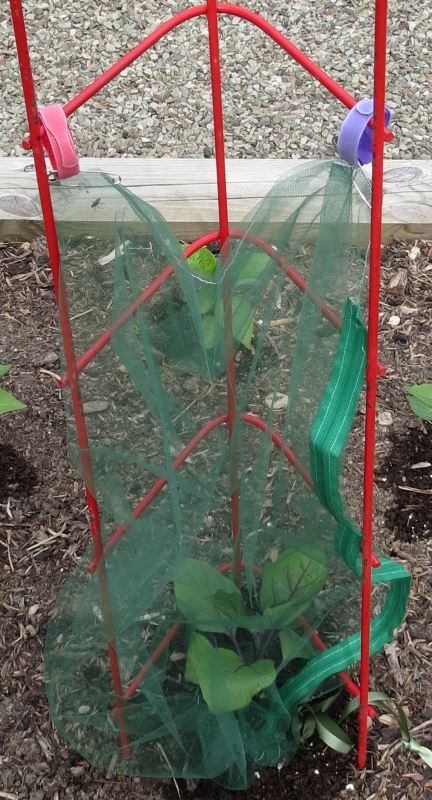
Since eggplants are self pollinators, and do not require bees to spread pollen from flower to flower, it is a viable alternative to bag them.  Some people use floating row covers.  I don't have rows of eggplants, and I wasn't too keen on the idea of billowy white bags over each plant like runaway pillow cases. When saving seeds for tomatoes and other self pollinators, I have used small, white, tulle drawstring bags which craft stores sell for putting in wedding favors.  I decided to make giant versions of these.  But how would I get the fruit out?  Or hand pollinate them if need be?  I couldn't be ripping the bag off each time and then stuffing the plant back in.  The simple answer was to install a zipper down one side.  Now I realize, these bags do not hermetically seal the plants. Some beetles will still get in.  After several days I have found a couple of beetles on the leaves which I have squished.  But, when you know for a fact you have a gozillion beetles jumping about, one per plant per day is a ratio I am comfortable dealing with.


And sew I set out to make the invisible, green, tulle eggplant condoms with side zippers.  They turned out pretty well.  I pinned Velcro cord organizers to each corner to suspend them from the plant supports, and used pretty green satin ribbon as the drawstring, which probably won't be pretty and satiny or even green for long.  The green tulle is sheer enough to allow air and sunlight in and allow visual inspection for other pest infestations.  And speaking of other pest infestations, the barrier theory is adaptable to other pests as well.  Take for instance slugs and cut worms in your cucurbits.


Two years ago, my cucumber transplants began to mysteriously damp off.  Or at least that was what I thought was happening.  The conditions didn't make that seem possible.  After several days of this, as I crawled along on my hands and knees peering under plants, I noticed baby slugs, so tiny that you could line two of them up end to end on a grain of rice, were gnawing away at the stems.  Some of them survived as the stems scarred over.  Applying Diatomaceous Earth at the base, and setting out trays of beer kept them under control.


Last year I had my first real trouble with squash vine borers.  They chewed the heck out of this zuchini plant.  Now, zuchini are tough.  You can cut the invader out, cover the damage with soil and water well for a few days and the plant will probably survive.  In fact, this one carried on with no intervention at all for many weeks.  But again, I don't want to look at gnawed on plants anymore than I want to replace them.  So, preventative measures were in order.  We saved toilet paper rolls all winter.


Planting your cucurbits in toilet paper rolls will ward off slugs, cut worms, and squash vine borers because the little buggers crawl along the soil looking for an unattended stem to eat.  If all they find is a cardboard wall, they will move on.  Hopefully.  Plants this size are easy to thread through the tube.  If the tube comes unglued with water damage, or the leaves are too big, just cut down the side and place two over lapping tubes around the stem.  And why, as my husband asked, use cardboard rolls which are sure to fall apart and not some sort of plastic collar?  #1.  They are organic and can be thrown in the compost #2.  They are FREE (more or less) and #3.  There is a guaranteed constant supply of them.


Another barrier is used stockings.  This has the advantage of being long enough to protect a length of stem which may be lying along the ground.  Here I have my zuchinni dressed with a toilet paper roll and a knee high stocking just waiting to be pulled up the stem.  Again, FREE (more or less), a guaranteed constant supply, and they expand to fit.  What more could you want?

This is one of those pauses in gardening.  The seeds are sewn.  The plants are transplanted.  The peas, the flowers, the potatoes and the carefully coddled tomatoes. Everything is trimmed, weeded, edged, mulched, protected, mowed, hoed and hilled .  Plans have been laid.  Hopes are high.  And now.... we wait.

Saturday, May 25, 2013

You Can't Always Get What You Want


You can't always get what you want 
But if you try sometimes, well you might find,
You get what you need 
                                      ~ The Rolling Stones

Spring is here and well underway.  In fact, we've had several weeks that felt like full blown summer.  We've been busy in the garden and landscaping.  We've enjoyed daffodils and asparagus.  The peas are growing wildly.  Tim has removed 22 dead or dying ash trees, cut them up, burned the tops, pulled the stumps and graded the meadow.  I've edged and mulched the first half of the landscaping. Yup. We've been busy.

It was a banner year for daffodils

Spring is the time of year when you begin to see what your gardening year is going to shape up like.  The first surprise is finding out what did or did not winter well.  Surprise, the Hollyhock which had been thriving and reseeding itself for several years under the dryer vent decided to die off.  As did three Mums, two Veronica and a Butterfly Bush.  Sometimes there is an easy explanation and sometimes not.  As compensation, one clump of oriental Poppies has tripled in size (and now needs to be moved), another Bachelor Button decided to volunteer in a perfect spot, and all the finicky shade loving refugees that I put behind the mulch bunker are thriving in their preferred habitat.  There are trade-offs in this hobby.

The Hollyhock in better days
Whether your dream garden is a cottage garden full of Hollyhocks, Lupines and antique Rose varieties, bushels of perfect tomatoes or neat and orderly rows of alternating red and green lettuces you are bound to suffer a disappointment now and then.  You just never know what its going to be ahead of time.  Ten years into my gardening career, I've learned not to take this too hard.  There's probably next year.  And a gal can get tired of eating eggplant anyway.

I start most of my own vegetables myself, especially the ones that are fussy and require the longest head start.  I buy replacements for what fails.  I've gotten to know what I can replace and what needs a special effort if I am going to enjoy it this season.  This year my lettuce was a flop, but the Alaska Nasturtium took off like mad.  Go figure.  Either one of those is fairly easy to replace if you know where to look and get an early start on your shopping list.

My rule is you can never have too much Alaska Nasturtium.  It adds color to the predominately green pallet of my vegetable garden and it's a great edible garnish for salads too.

I've gotten lazy about tomatoes.  I no longer start the first of April with a "grow op" in the dining room, heat mats, lights on timers, and fans.  It's just too much bother.  Instead I start them the first of May in the cold frame and forget about them.  

My Jap tomato transplant Memorial Day 2012

When planting time comes they are just putting out their first true leaves and can barely see over the soil line, but not to worry.  They catch up surprisingly fast.  They won't set any records for early ripening dates, but I make sure to buy one regular sized transplant to hold me over.  Last year it was the Paul Robeson.  

My best and favorite source for fancy tomato varieties is my friend Mickey.  She has similar growing tastes and operates a small and personalized little greenhouse (yes, just one greenhouse) where she starts her own plants for her own garden and produce stand, and sells the extra to the public.  Also, she will sell you just one of anything, and at about a quarter of the price the large nurseries charge.  She is the one who turned me on to the Paul Robeson, the Giant Pear paste tomato, and Ichiban eggplants.  In return I give her some seeds I think she would like such as the Barlow Japs and the Absinthe.

A mouth wateringly delicious Absinthe

This year I started the Japs (must supply the family), the yellow Dr. Wyche, black Paul Robeson and the green Absinthe.  These are my absolute favorites and represent most of the color wheel.  I was particularly looking forward to the Absinthes.  All of them came up, except for the Absinthe.  How frustrating!  I could probably replace a yellow or black tomato, and the Brandywine, especially the pink strain, is a suitable substitute for the Barlow Jap and available almost everywhere now.  But where in the world am I going to find another green tomato plant commercially?

My last stop in my greenhouse run is usually Mickey's.  By coincidence, I landed there just as my mother was leaving with several flats of tomatoes and other vegetables including a cherry tomato variety she had supplied Mickey with seeds and had her custom grow.  I found Mickey's list of tomato varieties in it's usual spot by a pole and began to look for a replacement variety, something new and unusual that I can fall in love with.  Right at the top, second in line was Absinthe.  "Absinthe!  You have Absinthe!  Do you have any left?"

"Sure.  This is the first year I saved seeds from the ones you gave me."  Mickey casually produces a pair of scissors and dives into a flat of Absinthe.  "Do you prefer tall or stocky?"  Like magic she removed a beautiful, stocky eight inch plant from the flat and handed it over to me.  It was like Christmas morning!  I almost jumped up and down with glee.  I could barely concentrate as I asked her for a Sungold, two egg plants (one long Asian variety, and a standard) and some short and stocky basil plants.

I paid her my $2.50 (yes $2.50.  That's 50 cents a plant) and left with my treasures thanking her profusely and declaring my undying devotion.  At home I carefully watered and placed the new arrivals in the cold frame where they will give my plants something to look up to for another week while we wait for this cold snap to pass.  I sorted through my empty pots of disappointment and dumped the dirt back in the bin, counting and organizing cucumbers, peppers, eggplants and tomatoes.  Now the question remains.  Do I have enough tomato plants or should I go back to Mickey's now that I've regained my senses and pick up another fun variety, or two, I remember seeing on her list.

The gardening season has begun and the survivors and I are soldiering on.  No, in gardening, as in life, you can't always get what you want.  But if you try sometimes, well you might find, you get what you need