Friday, October 29, 2021

Cold Rainy Days - Glögg and Dahlias

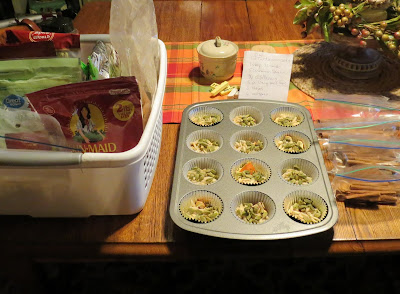
What better way to spend a cold, rainy autumn day than sorting spices?  I measured out bulk spices and bagged up enough for this year's Glögg.
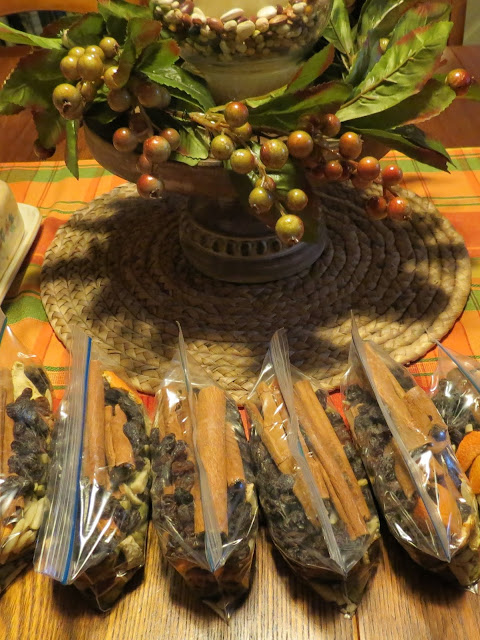
 
We used to wait anxiously every year for the spices to appear in the local Swedish bakeries.  A few years ago my husband decided that we go through enough of them that we should just buy in bulk.  Decades ago, his parents and their friends had worried that some day they wouldn't be able to get the old spice recipe (are worries inheritable?) and sat down and counted out each individual ingredient.  12 cardamon pods, 6 whole allspice berries, 6 whole cloves, a teaspoon of slivered almonds, a quarter cup of raisens, 5 cinnamon sticks, orange peel...  So we had the recipe.
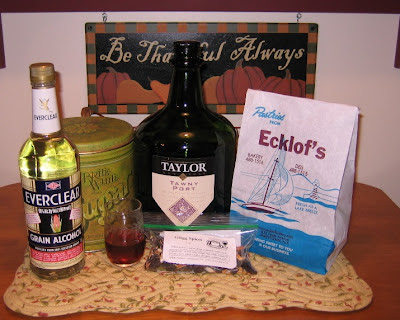

I order enough bulk spices through Amazon to get us through a few years.  I bag them up each year and pop them in the freezer to keep.  The store bought orange peel leaves something to be desired so I buy a bag of oranges to eat and set the peals out to dry.  Free orange peels! This little enterprise drops our per batch price for the spices from fourteen dollars and change down to a little over four bucks a batch.  Now that's what I call economy of scale!

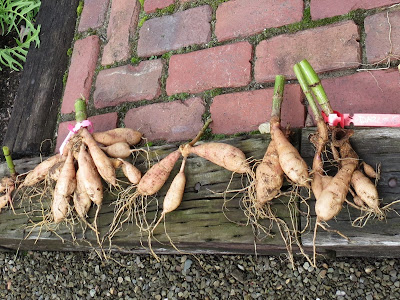
We may be completely saturated with rain.  We may not be able to walk across the lawn without getting a boot stuck.  But they haven't all been gloomy days.  We have not had a hard frost yet, but I've been working through my dahlias lifting the tubers to store.   In the past I have just knocked off the worst of the dirt and plopped them into cardboard boxes of compost or potting mix and stuck them in the basement bulkhead.  This year I am trying to be a little more precise about the process.  After all, I have the time.  I've found a lot of information online about the best way to store the tubers and there are several methods and variations of storing.  My old method is fine.  But in the spring you end up with a stack of collapsed boxes of dirty, mystery tubers and they aren't any fun to unbox and plant.


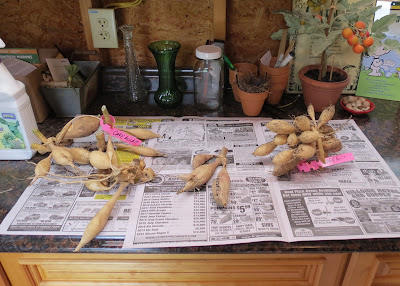
Even though we've had too much rain and the dahlia bed was wet and sort of muddy, they rinsed off really nicely.  I dug up and processed one variety at a time.  None of them showed any sign of disease.  I hosed them off and each day set them outside to dry for the afternoon.  At the end of the day I bring them in and set them on newspaper over night.


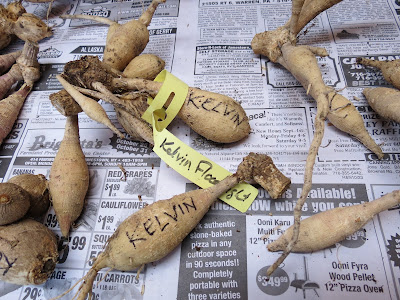
The next day I trim off the hair roots and cut the stem back to the solid part (the rest of the stem is hollow and can hold moisture or debris).  After they have dried for 24 hours they can be handled without scraping them up.  The hair roots cut cleanly and you can write the varieties on them with a marker.  You can let them dry 48 hours or so before you pack them up but after that you will start to notice that they are beginning to shrivel a little and you don't want that.


It is important to cut out any damaged or rotted tubers because you don't want them continuing to rot in storage and spoiling the whole batch.  You can divide the clumps at this point but I am going to wait until spring.  Some of them separated out on their own for me which was nice.  But the rest will have to be cut up and that will be easier in the spring when their growth eyes start.


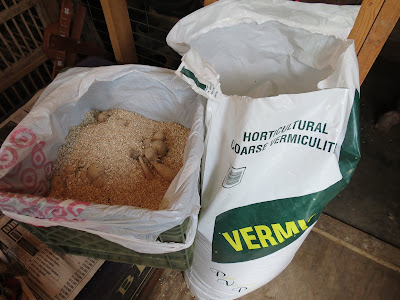
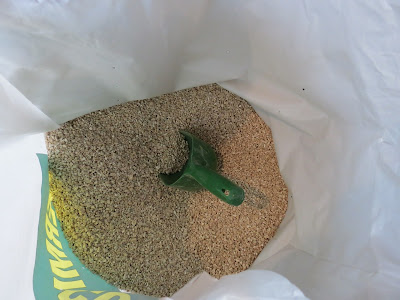
I ordered a twenty pound bag of coarse vermiculite from Farmtek. This will keep them clean and should maintain the right amount of moisture without being "damp".


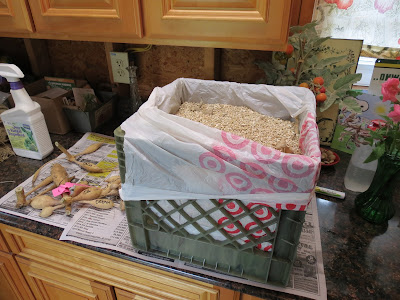
I still have some of them in boxes, but I picked up a couple of these plastic milk crates and now I want more!  They have handles on all four sides, are light weight, and won't crush when I stack them.  I had shopping bags the right size and they packed up really nice and tidy.


They need to be kept cool but unfrozen.  They can stay in the garden shed for now but will have to come in to the basement bulkhead for the winter where they will have the right amount of humidity and will not freeze.

Tomorrow's cold rainy day project is venison jerky.

Wednesday, October 13, 2021

Harvesting Leaves

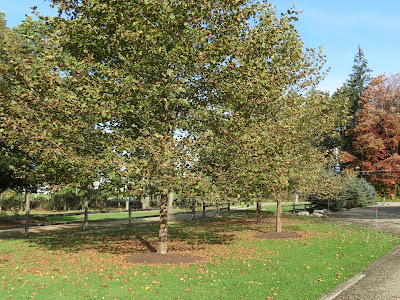
 Leaf season has begun!  And it could last until Christmas.  Seriously.  It will snow in November/December but we will get a thaw and then we will get back out there and work on the oak leaves knocked down by the winter weather.  And then next March we will have one last round of cleanup.  But right now its not a huge chore.  The lightweight Poplar, Maple and London Plane leaves are the first to come down.  This used to be Ash leaf season but all of our many ash trees have died and most have been removed.


Cleanup phases in slowly with the battery powered blower, spending twenty minutes blowing a few leaves out of the landscape onto the lawn to be mulched by the lawn mower and it will end with twice a week sessions with the neighbor and three abreast gas powered back pack blowers blowing knee deep, thick, leathery red oak leaves back towards the woods whichever direction the prevailing winds will allow that day, then getting the lawnmower out and mulching them into the woods.

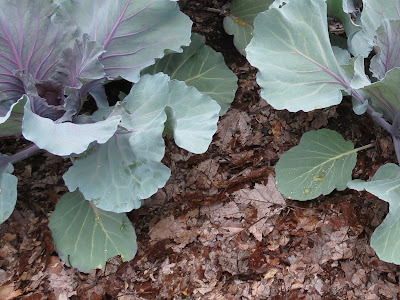
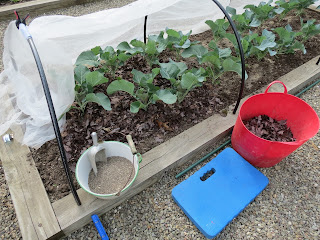
Shredded leaves keep the cabbage patch tidy and weed free.
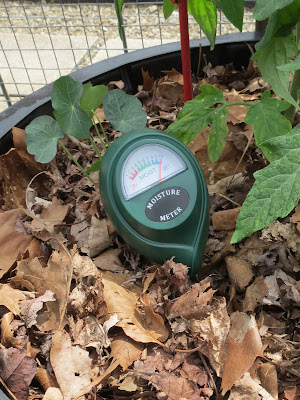
I have a good use for shredded leaves and I consider this a resource to be harvested.   I use the leaves as mulch for my raised beds and containers and find they make a big difference in weed suppression and moisture retention.  

Not only does mulch keep the soil cool and moist it
prevents rain water from splashing up onto plants.
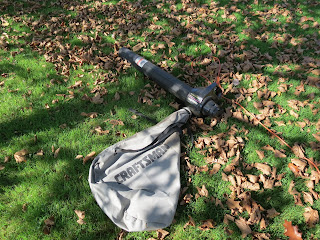
These early, light and easily shredded species are the ones I want.  I string out the extension cord and get out the old Craftsman leaf sucker/blower. 


I can get about eight blower bags into a large leaf bag if I take the time to compact it a little.  My husband watched this process and suggested I run the leaves through the shredder a few more times.  That way they will be smaller pieces and less likely to blow around in the garden when I spread them as mulch next year.  I'd been thinking about trying that....

Eight blower bags of Maple leaves compacted and ready to tie up.

Another four blower bags of London Plane leaves.
It sure would be nice to get it all into one bag.
Four bags become two bags
Two bags become one bag
The first full garbage bag gets run through twice more and 
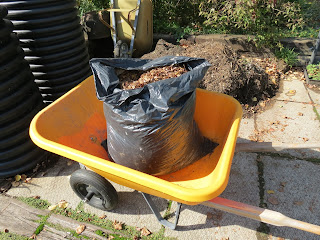
now all twelve are stored in one garbage bag!

There are plenty more where these came from.  The Maple tree by the firepit and three London Plane trees have just started turning and dropping.  I know there are a few other ways to do this.  Some people use the lawn mower to round them up and them put them in the compost pile.  Some people put them in a barrel and use a string trimmer to chop them.  

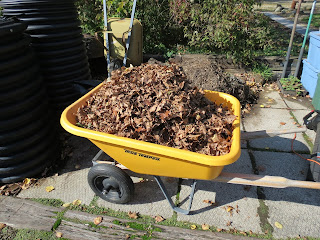
I like the leaf sucker.  For one thing with the amount of leaves pictured in the first photo, it only takes about two to three minutes to fill a blower bag.  Honestly the only real hassle is getting the extension cord strung out and then wrapped back up.  The actual chopping is really fun.  And then if I just dump the bags into the big wheelbarrow to accumulate the processing and bagging doesn't take much time either.  Then I have bags of nice dry leaves to work with next summer.

I stack the bags in the compost area until spring and then as needed dump them back out into the wheel barrow to fluff out a bit before filling a TubTrug with them to neatly apply them to a bed or container.


Last year sixteen blower bags got me through the season.  When I cleared a bed to plant a cover crop I used the shredder to pick up all of the leaves and move them to another bed for reuse.  I hope to get one or two more garbage bags stored then I will have a wealth of leaf mulch.

Tuesday, October 12, 2021

Looking Ahead to Spring - Tulips

I love tulips, but those of us who have heavy deer pressure have to be careful because tulips are a whitetail's absolute favorite snack.  Sometimes I plant them right up against the house or in containers, but I don't think I've ever actually planted them in my raised beds.  When I did my layout and planting dates for next year I realized that I have a couple of beds that I won't need to plant until July 1st.  Well that would be a perfect spot for tulips!  I can enjoy them in the garden and I won't feel as bad about cutting them and bringing them into the house as I do when they are in the landscape.


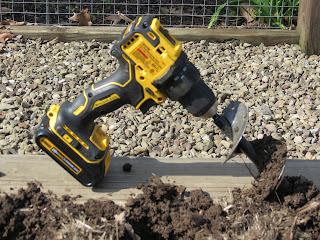
I ordered myself a Power Planter Bulb & Bedding Plant Auger (3"x7") and over the past few days I've planted seventy bulbs in this bed.  The auger makes short work of it and will also be useful for planting annual transplants.  I have about two and a half feet of empty space at the end for some spring planted bulbs like anemones or ranunculus.


These are the varieties I chose

Charming Beauty


Gudoshnik Double Late Mix

Parrot King

I haven't made a final decision on the spring planted bulbs, 
but these are the ones that I will likely choose from

De Caen Midnight Mix

Ranunculus Super Green Mix

Freesia


Monday, October 11, 2021

The Last of the Late Beans

I was going to pull these plants last week after I picked beans because I thought I had gotten all of the beans and there isn't enough time left in the season for these to rest, bloom again and produce a second crop.


Evidently I was wrong about having picked all of the beans.
These plants have to come out sometime to make more growing room for the late cabbage.
So out they came.


Much more room!


These are Violaceo de Verona cabbage and they are beginning to make nice heads.

Thursday, September 30, 2021

Sometimes Gardening is Hard Work

The other day I noticed my husband had gone out to the new cleared "meadow" with a wheelbarrow and a crowbar to pry up some largish rocks that were buried in the area we will have to brush-hog.  His choice of tools and lack of scheduling indicated the level of effort he was planning to put into it. Minimal. Then, I noticed he had gone for the big tractor and a logging chain.  Something was afoot.

He had come across a concrete slab buried in the mud near the road.  Over the years we've put some concrete in the area for fill.  This was not that.  This was heavy old concrete that pre-dates any of our existing information (which goes back almost hundred years).  It appeared to be poured in place.  It had no date on it which was fairly common practice.  And it was heavier than anything we had equipment to move.


Unfortunately the backhoe is off the tractor for the winter.  Our 43 hp tractor was able to lift the weight but having no backhoe meant the tractor did not have the balance to control it.  I should have taken photos of the nearly one ton slab dangling from the loader, but at the time I was standing on the back blade trying to keep the tractor from tipping over.  We got it to the road and were going to continue on, but had we suffered a mishap like a blown hose or a peeled tire we would have been in a pickle.  So it was dropped at the edge of the drive.  We borrowed the neighbor's jackhammer and cut it down to size.  Then we threw it back in the mud.  There is one area out there that is going to need a lot of fill to make it accessible.

Each of these chunks was barely liftable by one person.  About 100# each.
The slab was at least a foot deep and full of gravel.

Now that autumn is underway I have been gradually cutting down the ugly and cleaning up for leaf season.  The garden is nearly completely empty.  Two beds are in use and seven of the beds are mulched.  Two are still growing Buckwheat and the last one will have tulip bulbs planted before mulching.


There are still plenty of pretty things in the landscape.

Miscanthus purprescens
"Flame Grass"

The heads of the Japanese Silver Grass look like fireworks.
The effect is much more dramatic in 3D


Now that I'm outside a little less it is easier to cut Dahlias and bring them in.  Especially before a day of wind and rain which will only break the heavy blooms down anyway.

Belle of Barmera was the last variety to bloom but was worth the wait.

Rebecca Clematis Vine round two

Hawthorne berries along the natural edge

We repainted the bedroom and finally put out the new bedroom set I've had in a box since July 2020
We've never had such heavy, cozy drapes and are getting ready for winter hibernation.

Today is dry but cool.  Currently 52 degrees at noon with a forecast high of 58.  Partly cloudy and breezy.  I have thick pork chops in the slow cooker and a glass of cider at the ready.
A pre-hibernation practice run.

Parting Shot:  a closeup of Belle of Barmera


Monday, September 27, 2021

The Bartlett Pear


I just ate the last one of those Bartlett pears.  I really wasn't expecting to blog about every pear I eat so I wasn't being obsessive about pictures.  But - pears can be tricky because they ripen from the inside out.  And I have a little learning curve on Bartlett ripeness...  I ended up with three Bartletts from the Chilly Pear Tree and on the third try I got it right.  This pear had been in the fridge for at least two weeks.
 

That was by far the BEST pear I've ever eaten!
Not only because I've worked so hard to get it.

And I still have a Bosc to go.  I'm a lot better at figuring out when a Bosc is ready to eat because I grew up with a Bosc tree.  Right now our lives are all about apples, so it can be easy to forget about a couple of pears tucked into the fridge.


Tuesday, September 21, 2021

Preparing Horse Radish

 When I was digging potatoes I kept running into really nice horseradish root.  It is a little early in the season to harvest horseradish because cold weather brings out the flavor.  But its still good even if it isn't really hot.  So I don't waste it. I have three big clumps of horseradish along this bank.  Two of them stay nice and tidy and never try to wander off.  But this newest clump is next to a planting area which I am always digging up.  Not only is the soil soft and inviting, but it seems like each time you break a root it uses the opportunity to send up a plant at the breaking point.  

This nice little plant is not welcome here.

Whenever I come across a nice root, I dig as much of it out as I can.  Then I just pop it in a zipper bag and put it in the garden fridge.  My husband is on his way down the fall chores list and today he cleaned out the garden shed fridge.  Our house fridge was completely over run with beer and sweet tea and cabbages so it was a good time to deal with these roots.  This beats the heck out of digging them mid-winter when the ground is muddy and you're out in the snow with a pot of water trying to thaw the ground - but I do it that way too.  How else would we get fresh horseradish for home made cocktail sauce for our holiday shrimp?


The first step is to get a good veggie brush and scrub the roots clean.
These long, flexible carrot-like roots are my favorite to deal with not the coarse, gnarly type at the base of the plant.


Next, cut off the dirty, broken end and the little end that is too skinny to peel.


The roots are just like carrots.  There is no real skin to them, but you want to clean them up and inspect them.  The goal here is not to whittle them down to nothing.  Just scrape the discoloration off.


You could grate this by hand and if you want to  - more power to you.  But I use the food processor.  Here is also where they stop acting like carrots.  They are quire fibrous and tough to chop. You'll need a good chef's knife to dice the roots into something your food processor can handle.


Nothing special here, just a little 3 cup chopper.  I start with just a handful of root.


As the first ones get to a good consistency I keep adding more.  I put about half a cup of water in too to get the mixture moving.  You want to keep shredding until you get quite a fine mixture.


The consistency will begin to get pasty.  You can use vinegar instead of water if you want.  The vinegar will stop and stabilize the chemical process so the longer you wait to add the vinegar, the hotter your end result will be.  If you want more mild taste, go ahead and use vinegar.  This time of year before the roots go dormant the flavor is more mild anyway.


Use a spoon the remove the horseradish leaving the liquid behind.


I use a spoon to pack the mixture down bringing more water to the top so I can pour the liquid off.


Top off the jar with white vinegar.  I use the spoon to loosen the jar contents and allow the vinegar to percolate down to the bottom.  Some people add salt but its not necessary. 


Now you have a jar of nice fresh horse radish that will keep in the refrigerator.  I always date mine.  It will keep for three or four months but will start to lose its kick after about three or four weeks. We use it mostly for roast beef sandwiches.  When fresh it makes absolutely awesome cocktail sauce.  Just find your standard cocktail sauce recipe using ketchup, Worcestershire sauce and lemon juice.